

Making incoming emails secure for the Group: a strategic challenge for CA-GIP




Cyber-attacks are on the increase, and banks are prime targets. Making incoming e-mails secure is essential to guarantee the integrity of information systems and the protection of sensitive Group data. What does CA-GIP do?
Cyber-attacks are on the increase, and banks are prime targets. Making incoming e-mails secure is essential to guarantee the integrity of information systems and the protection of sensitive Group data. What does CA-GIP do?
Implementing a strict policy for filtering emails from senders without a declared domain name is a key step in the fight against phishing, malware and fraud. But making incoming emails secure on behalf of the Group goes beyond that, as we will explain.
The risks associated with unregistered domain names
Failure to register or secure all the domain names associated with a company exposes it to spoofing, phishing, ransomware and BEC (Business Email Compromise) attacks. In practical terms, an attacker can register a domain resembling that of Crédit Agricole and send fraudulent e-mails to employees. These e-mails may contain malicious links, infected attachments, etc.
Some alarming figures:
| 80% of successful cyberattacks begin with a booby-trapped email. | 66% of companies suffered a ransomware attack in 2023 |
|---|
| The average cost of a ranswomware attack is estimated at $1.85 million | BEC attacks caused more than $2.7 billion in losses in 2023 |
|---|
For the Crédit Agricole Group, these risks are amplified by the highly confidential nature of the data processed and the complexity of its organisation.
CA-GIP: a proactive approach to securing incoming e-mails within the Group
In response to these threats, CA-GIP is implementing a global strategy for securing incoming e-mails, based on strict filtering of messages from senders without a registered domain name. This approach is based on several key principles:
1. Optimising the use of anti-spam mailboxes:
After analysing the hardware capabilities of this equipment, CA-GIP was able to adjust their configuration in order to carry out more complete scans on a greater volume of incoming emails. In fact, in addition to the standard reputation filter, applied to all e-mails, antispam mailboxes are capable of more complex analyses of content, structure and any URLs embedded in the message.
| Within the group, over 15 days, 620,000 emails were identified by the anti-spam engine, including 1,860 thanks to optimisation of its configuration. |
|---|
2. Checking the legitimacy of the sender of the email:
This measure will be implemented in March 2025. The principle is simple: CA-GIP will check whether the machine that sent the e-mail is legitimate. To do this, there is a standard on email exchanges that allows you to state which servers can send emails for which domain. Technically, this amounts to checking the SPF (Sender Policy Framework) and warning users of potential fraud via a TAG in the email subject.
| [Projection] Within the Group, over a 15-day period, 60,000 emails could be identified with an SPF FAIL. |
|---|
3. Enhanced checking of attachments:
This measure will be implemented in March 2025. We will update the list of rejected potentially dangerous file extensions in accordance with the recommendations of the main public email providers. This is what you will receive when an attachment intended for you has been rejected:
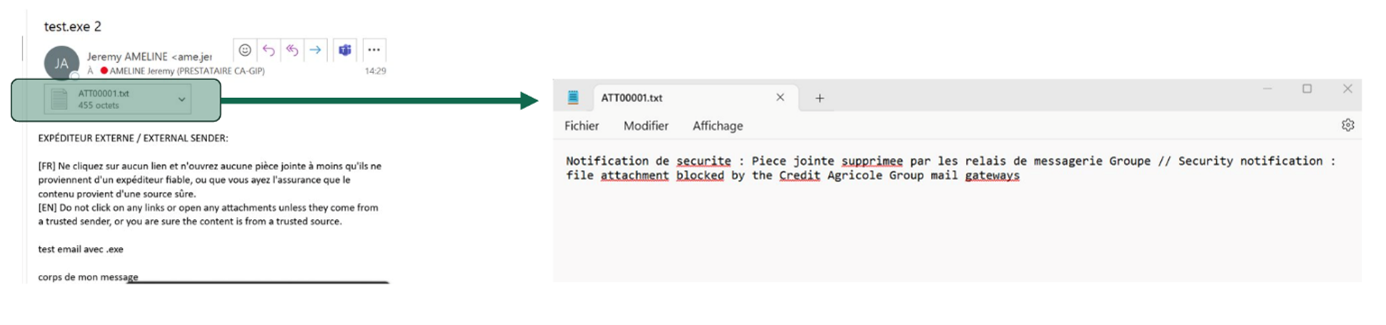
| [Projection] Within the Group, over a 15-day period:16,500 attachments would be blocked by the new list. &30% of emails would be blocked upstream by the sender's reputation filter . |
|---|
A strong commitment to cybersecurity at Crédit Agricole
With this incoming e-mail security policy, CA-GIP is strengthening Crédit Agricole Group's protection against cyber attacks and fraud attempts. This initiative is part of a wider effort to guarantee a reliable digital environment, in line with the security challenges facing the banking sector.
In a context where threats are constantly evolving, collective vigilance and the adoption of good practice are essential. Every employee of the Group plays a key role in protecting the bank's data and customers. By providing tailored support and raising awareness on an ongoing basis, our experts make cyber security a priority shared by everyone.