


Two periods in the Group’s history can be distinguished from its presence in Egypt. The first, about 75 years old, concerns the branch network created by Crédit Lyonnais between 1874 and 1956, the year of the Suez crisis and the nationalisation of banks. The second began 20 years later, when Crédit Lyonnais relocated to Cairo, followed shortly thereafter by Banque Indosuez and Crédit Agricole. Through various acquisitions, Crédit Agricole Egypt was successfully formed..
Crédit Lyonnais
A first period of establishment of the Group in Egypt was linked to the creation by Crédit Lyonnais of a branch in Alexandria in 1874. It was one of the first in the international network that the bank was building. However, this presence came to an abrupt end in 1956 following the Suez crisis: Crédit Lyonnais branches were nationalised and the bank was forced to leave the country.
Crédit Lyonnais will not return to Egypt for around 20 years. In 1975, he signed an agreement with the Central Bank of Egypt and opened a general representation in Cairo the following year, while taking a share in the capital of Misr International Bank.
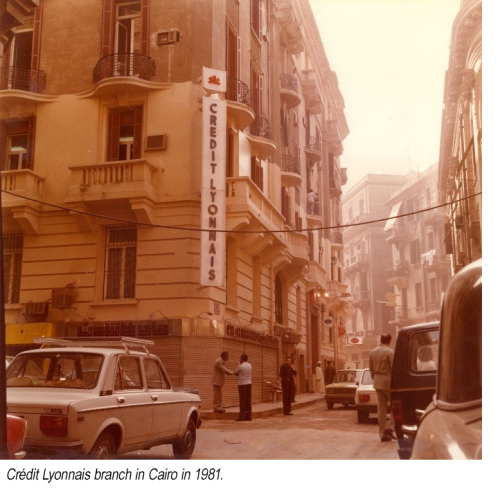
A fully-fledged branch was opened in Cairo in 1980 to carry out banking operations and establish partnerships. For several years, the results have been good and the bank has supported major national projects such as the Cairo metro and the extension of the port of Damiette. The general representation, which is maintained in addition to the branch, extended its area of competence to Jordan in 1984.
The first Gulf War did not have a significant impact on the operation of the agency and performance levels remained good throughout the 1990s. Crédit Lyonnais continues to provide financing for major projects, particularly in the energy sector.
In 2002, the bank lightened its Egyptian structures, but it was still present in the country when it joined the Crédit Agricole Group in 2003.
Banque Indosuez
Indosuez looked to Egypt before establishing in physically. In 1981, the bank financed the construction by FGE and Fougerolles of two hospitals and the acquisition of two Airbuses ordered by Egyptair. Banque Libano-française, a subsidiary of Indosuez, also has activities in Egypt.
Banque Indosuez finally opened a representative office in Cairo in 1982 to expand its already large business volume. This office provides assistance to French exporters in what was then a booming market. Project financing in the country is a succession of projects, but Indosuez is not looking to build a network of Egyptian branches. The representative office was therefore the only establishment of Indosuez abefore the take over by Crédit Agricole in 1996.
From the Caisse Nationale de Crédit Agricole to Crédit Agricole Egypt
In 1984, Crédit Agricole opened a representation in Cairo. At that time, it was in the midst of creating its international network and its presence in Egypt was motivated by its desire to support its agri-food sector customers in this country, of which France was the second-largest supplier. In addition, Crédit Agricole has previously participated in the financing of agri-food imports and agro-industrial projects. In 1988, the Cairo office extended its representative missions to other countries in the region.

Inauguration of Crédit Agricole’s representative office in Cairo
(extract from internal press, CNCA Info, 1985).
In 1996, Crédit Agricole acquired Banque Indosuez to form Crédit Agricole Indosuez (CAI). This new Crédit Agricole corporate and investment bank therefore remains present in Egypt through a representative office.
The situation changed significantly in 2001: Crédit Agricole Indosuez took control of Crédit International d’Egypt, a bank listed on the Cairo Stock Exchange. The new entity is called Crédit Agricole Indosuez (Egypt) SAE. With three branches on the outskirts of Cairo and 160 employees, it covers a wide range of activities: market and investment banking, corporate and private banking.
In 2004, as part of the merger between Crédit Agricole and Crédit Lyonnais, CAI (Egypt) SAE acquired the Crédit Lyonnais branchsubsidiary. The following year, CAI (Egypt) SAE was renamed Calyon Bank (Egypt) SAE.
2006 was another important milestone in the Group’s presence in Egypt. Calyon Bank (Egypt) SAE takes over Egyptian American Bank SAE. Following this transaction, it was decided to remove Crédit Agricole’s Egyptian subsidiary from Calyon. It changed its name to Crédit Agricole Egypt and is part of Crédit Agricole S.A.’s International Retail Banking division.
The following years saw the renovation and expansion of Crédit Agricole Egypt’s commercial network (nearly 70 branches in 2009). From 2010 onwards, the bank gradually reorientated its offer towards the medium/high-end market while retaining a role as a local bank and as a financier of SMEs. The January 2011 revolution did not have too great an impact on Crédit Agricole Egypt’s business, which continues to generate good results. It opened its new headquarters in 2014.
Consistently ranked in the top rankings of banks, Crédit Agricole Egypt has developed a regularly award-winning digital offering and continues to offer its services to individuals and businesses.