
History of the Group’s presence in Luxembourg


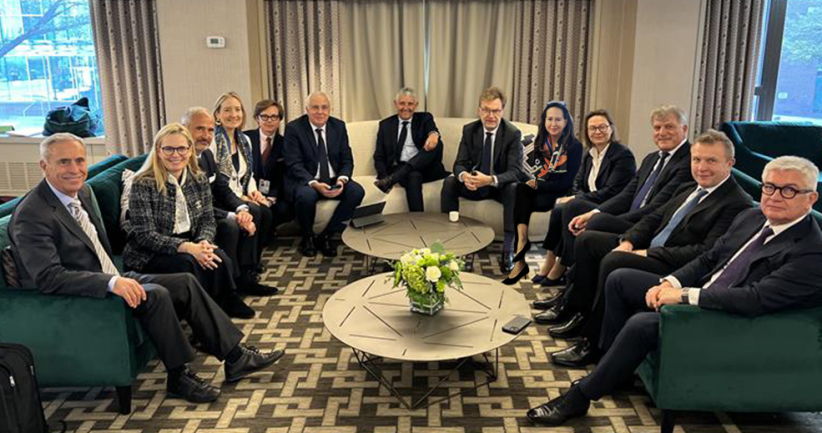

In Luxembourg, the Crédit Agricole Group is a long-standing player in private banking. Its oldest presence is due to Crédit Lyonnais, followed by Banque de Suez, Banque de l’Indochine and Caisse Nationale de Crédit Agricole. From 1990 to 2000, new activities were established to define the Group’s current activities in the Grand Duchy.
A first establishment created by Crédit Lyonnais
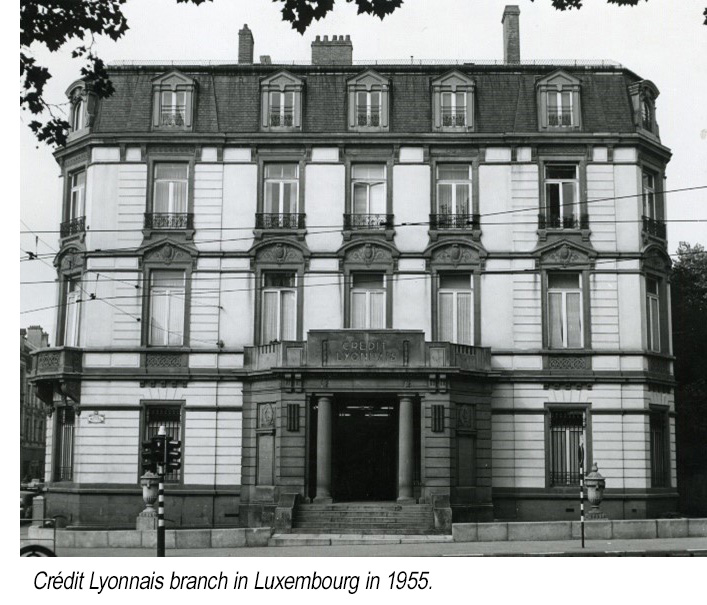
Crédit Lyonnais was responsible for the Group’s first establishment in Luxembourg in 1929. However, this agency has a short lifespan: it was wound up in 1939. However, the building still belongs to the bank, which hopes to reopen its head office after the war. Fortunately, there was no damage to the Agency and, as early as 1952, it appeared again in the annual reports.
Gradually, the Luxembourg office specialises in private banking. In 1971, a wealth management department was created with the installation of an advisor specifically dedicated to this area. Two years later, Crédit Lyonnais created Fiduinter, a wealth management subsidiary in Grand-Duché. Well established in the 1980s in this business, the Lyonnais also created Corelyon, a Luxembourg-based reinsurance company.
In 1990, the branch was incorporated under the name Crédit Lyonnais Luxembourg SA and an office branch was maintained. Wealth management is still its strong point during this decade, to the point that a wealth engineering competence centre was created in 1999. When Crédit Agricole S.A. took over Crédit Lyonnais in 2003, Crédit Lyonnais Luxembourg SA was merged with Crédit Agricole Indosuez Luxembourg. The new entity was renamed Crédit Agricole Luxembourg from July 2005.
Banque de Suez, Banque de l’Indochine and Banque Indosuez in Luxembourg

In 1969, Banque de Suez and the Union des Mines joined the capital of La Luxembourgeoise, a banking and insurance company created in 1920. Under pressure from the European Commission, the two activities are separated and the new subsidiary Banque de Suez - Luxembourg takes over the banking sector. At the same time, Banque de l’Indochine set foot in the Grand Duchy in 1974 with Banque de Benelux - La Luxembourgeoise as its affiliated correspondent. A year later, Banque de Suez et de l’Union des Mines and Banque de l’Indochine merged to form Banque Indosuez.
En 1980, Banque de Suez - Luxembourg was renamed Banque Indosuez Luxembourg SA. This subsidiary opened its new headquarters in 1983. As with Crédit Lyonnais, Indosuez specialises in wealth management in Luxembourg. The Group is also expanding its presence to provide services to institutional clients.
After the takeover by Crédit Agricole in 1996, Indosuez still had two branches in Luxembourg: a branch office and the subsidiary Banque Indosuez Luxembourg SA with a fairly wide range of services, both for individuals and institutions.
Crédit Agricole acquires a foothold in Luxembourg with the creation of Sicav
It was not until 1987 that Crédit Agricole intervened in Luxembourg. Contrary to the previous examples, this does not involve the creation of branches or subsidiaries but the development of a range of locally listed SICAVs. In 1988, the subsidiary Union d’études et d’investissement also created a venture capital fund: Eurocontinental Ventures. It was not until 1989 that the Caisse Nationale de Crédit Agricole opened a subsidiary located at 18 Boulevard Royal.
With CNCA Luxembourg and its other offices in Geneva, Hong Kong and New York, Crédit Agricole developed its wealth management business abroad in the early 1990s. The acquisition of Banque Indosuez in 1996 will give it a greater presence in this field. In 1997, Crédit Agricole Luxembourg and Banque Indosuez Luxembourg merged to form Crédit Agricole Indosuez Luxembourg. Next to this main location, a branch of Crédit Agricole Indosuez is maintained as well as the subsidiaries Eurocontinental Ventures, Fastnet, Indosuez Management Luxembourg and BGP Luxembourg. The latter was absorbed by Crédit Agricole Indosuez Luxembourg in 1999.
In the early 2000s, Crédit Agricole Indosuez Luxembourg was among the top three foreign wealth management institutions. At the same time, Crédit Agricole Asset Management (CAAM) is continuing to create financial products, particularly Sicav. In life insurance, Predica established itself in Luxembourg with the creation of Predicai-Europe. It will merge in 2004 with Federlux (created in 1998 by UAF, Crédit Lyonnais’ insurance subsidiary).
2002 was an important year from an institutional point of view with the spin off of Crédit Agricole Indosuez Luxembourg into two entities: CAI Luxembourg, dedicated to private banking; Crédit Agricole Investor Services Bank Luxembourg for financial services. This new subsidiary operates on behalf of institutional clients while capital markets activities is still managed within the Calyon branch on behalf of the two new banks.
In 2005, CAI Luxembourg merged with Crédit Lyonnais Luxembourg. The new entity takes the trade name of CA Luxembourg Private Bank and manages more than €10 billion in assets. Within two years, the new company took over the private banking activities of Banque Colbert (Luxembourg) SA and Bank Sarasin Europe SA. This series of mergers and acquisitions elevates CA Luxembourg Private Bank to the rank of the top five private banks in the Grand Duchy.
2005 also saw the creation of CACEIS, which was present from the outset in Luxembourg with Crédit Agricole Investors Services Bank Luxembourg. This subsidiary was renamed CACEIS Bank Luxembourg in 2006.
At the beginning of 2010, Crédit Agricole was present in Luxembourg in different businesses: in private banking with Crédit Agricole Luxembourg (which took the name of CA Indosuez Wealth Europe in 2016), in financial services to large corporationswith CACEIS Bank Luxembourg and Fastnet (both merged in 2011), in insurance with Crédit Agricole Life Insurance, in asset management with CAAM Luxembourg (which became Amundi Luxembourg SA in 2010 after the merger with SGAM Luxembourg) and corporate and investment banking with CACIB. These entities include the Grameen Crédit Agricole Foundation, which has been headquartered in Luxembourg since 2008.