
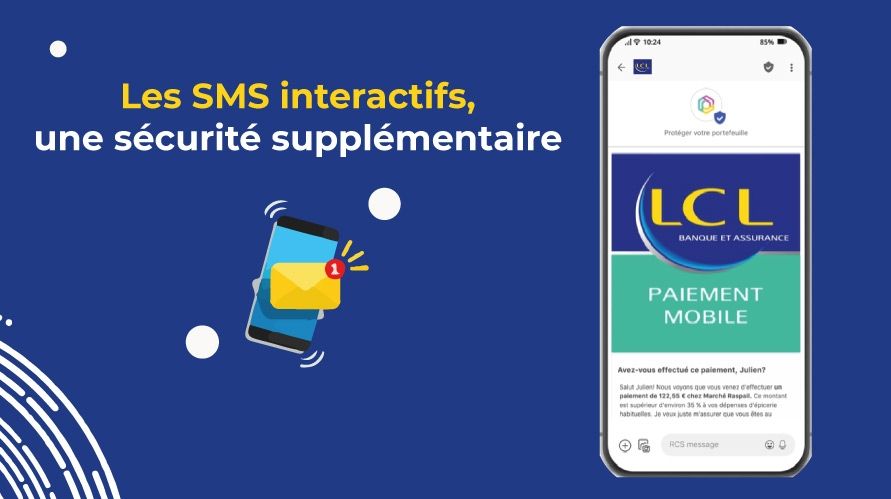
Interactive SMS, additional security



LCL is deploying interactive SMS messages to alert its customers in real time and strengthen the security of sensitive operations.
As part of its drive to strengthen its alerting solutions (alert launching and processing solutions), LCL has set up interactive SMS (SMSi) allowing customers to react in real time to certain sensitive operations, such as card payments, transfers or cheque deposits, in order to strengthen the security and responsiveness of the system.
What alerting solutions has LCL put in place?
Digital transformation has profoundly reshaped payment flows, delivering unprecedented fluidity and speed for customers. Unfortunately this growing digitalisation is accompanied by a resurgence of fraud, fuelled by the inventiveness and adaptability of fraudsters who are constantly exploiting new technologies and system vulnerabilities.
Faced with this persistent threat, it is important to place customers at the centre of the fight against fraud, by raising awareness, protecting them, but also by actively involving them in payment security processes.
Together with the Business Lines and CAPS, we have set up several alerting solutions. The first solution implemented was "SMSi Card" which was launched two years ago, and more recently, two new solutions have been put in place: "SMSi Transfer" and "SMS Cheque".
What is the SMSi Card?
When the GDR (risk management tool managed by CAPS) detects a suspicious card transaction according to internal rules specific to the tool and issues a fraud alert, the payment is blocked and we send an SMS to the PART or PRO customer (eligible for SMS) asking them to confirm or deny the transaction in order to debit their account or block the card in the event of proven fraud. In the event that the card is blocked, a new card is automatically ordered for the customer and a virtual card, if eligible, can be used by the customer before they receive the physical card.
Pending the customer response, some card limits are lowered. In the event of an unproven fraud alert, the limits are immediately reset following the customer's response.
If there is no response after 24 hours, SMS responses will no longer be taken into account and AVEM will have to contact the customer to process the alert.
What is a SMSi Transfer?
When the GDR issues a fraud alert on an IP (Instant Payment - Instant SEPA transfer) or SCT (SEPA Credit Transfer - Classic transfer), the transfer is blocked and an SMS is sent to our PART or PRO customer (eligible for SMS) to inform them of the alert triggered and to ask them to confirm the alert or deny it.
If the transaction is legitimate, the customer is prompted to re-enter their IP transfer. In the case of an SCT transfer, the transfer is released automatically.
If there is no response after 24 hours, SMS responses will no longer be taken into account and AVEM will have to contact the customer to process the alert.
What is a SMS Cheque?
When cheques issued by our LCL customers, above a threshold amount agreed for the PART or PRO account, have been credited to our customers' accounts, we send an SMS to the holder of the PART account or to the legal representative managing the PRO account to encourage them to contact their advisor in the event of suspected fraud on the cashed cheque.
How has agility contributed to the success
of these projects?
The complexity of developing our alerting solutions, involving multiple Squads from different Tribes, made the adoption of agility essential to the success of the projects. This transition has allowed us to gain flexibility and significantly improve the quality of our products. In addition, working in short cycles has encouraged agile and rapid adaptation to changes in business needs and the integration of customer and advisor feedback after going into production.
We have also implemented certain agile practices, such as code review, which has allowed us to build and maintain a team culture based on the quality of our developments.
Lastly, sprint retrospectives allow us to identify improvement ideas and continually include them within the team.