
Crédit Agricole Group in Egypt



In Egypt, Crédit Agricole is at the service of a clientele of individuals and businesses through Crédit Agricole Egypt.
A bit of history
Two periods in the Group’s history can be distinguished from its presence in Egypt. The first, about 75 years old, concerns the branch network created by Crédit Lyonnais between 1874 and 1956, the year of the Suez crisis and the nationalisation of banks. The second began 20 years later, when Crédit Lyonnais relocated to Cairo, followed shortly thereafter by Banque Indosuez and Crédit Agricole. Through various acquisitions, Crédit Agricole Egypt was successfully formed.
A 2nd-largest economy in Africa with prospects for recovery
Growth slowed to 2.4 percent in fiscal year 2023/2024 but is expected to recover above 3 percent in 2024/25 amid high but declining inflation. The decline in oil and gas exports and the drop in traffic revenues in the Suez Canal as a result of the Middle East conflict have taken a heavy toll on activity.
Inflation stood at 25% at end-2024 (compared to a peak of 38% at end-2023) and continues to weigh on domestic demand. Despite the normalisation of inflation as prices absorb the impact of devaluations, its decline has been dampened by the increase in regulated prices given the reduction in fiscal support to these sectors, spurred by the IMF programme. However, it is expected to fall more sharply in early 2025.
The implementation of IMF-agreed reforms and the massive inflows of foreign exchange since March 2024 have ended the series of devaluations that Egypt has experienced since 2022, and restored dollar liquidity, allowing the gradual removal of import restrictions. The conditions for recovery are thus being put in place, supported by a return of confidence and liquidity. Finally, the expected gradual easing of interest rates and the renewed dynamism of investment linked to the construction of the $35 billion Ras el-Hekma tourist site in the Gulf have stabilized the currency situation, which is now improving and should support growth.
On the fiscal side, Egypt faces a high interest cost on its debt, which will complicate consolidation. To address this, in 2025, the government plans to increase revenues by modernising and simplifying the tax system, particularly for SMEs, and improving incentives for informal sector enterprises to integrate into the formal economy. These measures are accompanied by privatisation plans amounting to 0.6% of GDP, which should help the budget.
In addition to the loans granted by the IMF, financial support agreements have been signed with the European Union, the World Bank and the European Development Bank.
However, the country remains highly vulnerable to geopolitical developments. A worsening of regional tensions could jeopardise the recovery and external equilibria. Nevertheless, Egypt remains a strategic crossroads in the Mediterranean, a veritable link between Europe and the Middle East/Asia.
Benchmarks 2023
Population: 114,536 million
Unemployment rate: 7.3%
GDP: $3,457/capita
GDP growth: 2.4% in 2023/24, 3.5% in 2024/25 and 4.4% in 202(/26 2025/26
Inflation: 33.3% in 2023/24, 21% in 2024/25 and 15% (e) in 2025/26
Public debt: 95.8% of GDP in 2023
CO2 emissions: 2.5 tons/capita (2022)
Sources : OCDE, Central Bank of Egypt, Crédit Agricole S.A / ECO
The forces at work
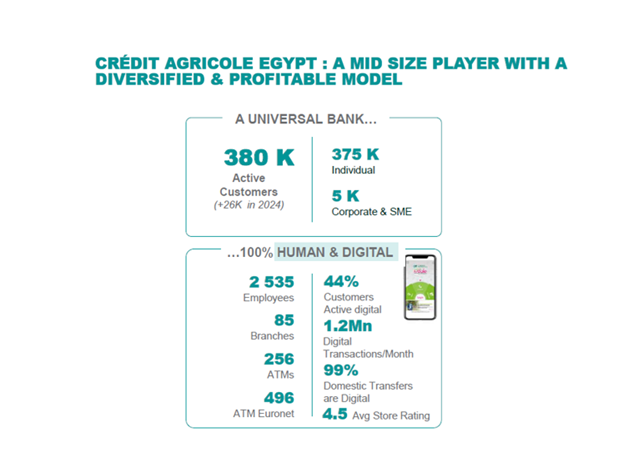
Launched in 2006, Crédit Agricole Egypt is the sole French Bank and a major European reference bank in Egypt. With 2,535 employees, located in 85 branches, the bank is leveraging its international expertise to better serve its clientele of 380,000 individuals and corporates (44% of whom are active in online banking), while supporting the country’s sustainable and economic development. In addition, it joined EGX - Cairo stock exchange index in 2015.
It is developing a universal banking model focused on client satisfaction while fostering synergies with other Group entities, in particular Crédit Agricole CIB and Indosuez, to support large clients and high net-worth individuals.
The bank offers a wide range of products and services, tailor-made financial solutions and expert advice to support all client’s segments. It also offers local corporate, multinationals and financial institutions with comprehensive banking services and strong expertise, particularly in capital markets, projects and trade finance and cash management.
Positioned among the most innovative banks in Egypt and awarded several prizes, it aims at offering best in class digital services, and accelerating the digital transformation of customer journeys by deploying modern technologies and further enhance operational efficiency.
In line with the Group’s Societal Project, Crédit Agricole Egypt has implemented a Net Zero approach with the ambition to reduce its carbon footprint by 25% by 2025, to be among the leading banks in sustainable financing and promoting inclusion.