-
View article
 #ACT2028
Recording of ACT 2028 LIVE : Crédit Agricole Savings - Think big for your money!
2026/05/18
- #Group Project
- 2020/11/06
- 0
-
9
The Group’s digital transformation
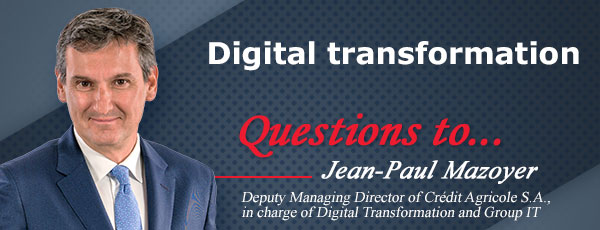
How can new technologies help us be more efficient?
They can improve our performance in four areas: customer relationships, internal processes, the efficiency of our people, and our information systems.
Our digital transformation depends on our ability to grasp and adopt new technologies in each of these areas. It lies at the heart of the Group’s Customer and Human-Centric Projects and forms part of each business’s overall strategy, supported at the highest levels.
These four areas work together and need to be developed at the same time. This requires a collective effort across the Group, with an imperative inherent in new technologies that are continuously changing: the need for constant monitoring and adaptation.
I’d like to give two concrete examples of how technology can be used to increase efficiency.
At an internal operational level, rolling out the Teams system will facilitate collaborative working between the Group’s 160,000 employees. The idea is to share information and be able to access it from anywhere, and at any time, within communities of various types (a business, a department, a project team that might have some external contributors, etc.). This project makes the idea of the “technology-augmented employee” a reality.
Meanwhile, we need to be aiming to reach customers via their choice of contact point, with relevant, ultra-personalised offers at key moments in their lives. Wider use of digital technology must from now on form the core of our new relationship model. On this subject, we need to enhance our applications so customers can access all the information and services they might need from their smartphones.
Where is the Group up to on digitalisation?
Within this unfolding digital transition, there are some initiatives that cut across the whole Group and others that are taking place at individual entity level. This is the strength of our model: each part of the whole can move ahead at its own pace, depending on its particular needs. The challenge today, though, is to speed up and scale up our digital transformation.
Moreover, our efforts up to now have mainly revolved around going paperless, with not enough focus on digitalising processes. Digitalisation goes further by rethinking processes and remote modes of interaction at the upstream level based on the range of technological possibilities available to us.
A concrete example is the digital signature, which is a real step forward. While it does away with paper, it does nothing to change the actual process. What it does is use technology to optimise the process. It’s now critical that we adapt our offerings and customer experiences in line with new behaviours. This means we have to innovate and be agile to shorten our IT time to market.
Internally, to be more productive we need to accelerate the rollout and harmonisation of collaborative tools across the Group and speed up our adoption of AI in all its forms.
What actions are you going to be implementing to support and speed up our digital transformation?
Our approach is underpinned by two prerequisites. First is a benchmark of bank and non-bank operators to provide us with an overview of the various use cases offered by new technologies. Open-mindedness and curiosity are key assets when it comes to pushing through our digital transformation.
Second, we need to acculturate everyone – employees and senior management alike – to the possibilities offered by technology. I call this the “technology quotient”, similar to the intelligence quotient and the emotional quotient. In this digitally-dominated world, we need to get better at understanding technology and building it into our thinking.
We then run into a technical issue: our information systems weren’t designed for real-time digital processing; they were designed to handle billions of operations as accurately and efficiently as possible, which means night-time batch processing. They do this very well… but that doesn’t help with our digital transformation.
Lastly, we have a data issue. At present, we don’t have a consolidated view of our customers, whose relationships can be shared by a number of Group entities. We need to do a better job of capitalising on data to get to know our customers better and improve performance.
We’re therefore going to be identifying how we’ll be using these technologies, mapping out a strategic vision and making some foundational investments to transform the Group’s core IT and support our digital transition.
Finally, I’d like to emphasise that IT also has a part to play in the Group’s approach to environmental and social responsibility. We’ll be factoring the impact of our actions and decisions in these areas into all our projects.
What’s the approach to IT governance within the Group?
Digital transformation is not just about transforming IT; it’s about transforming how the business works in general. It affects every entity, every senior leader, every employee.
This is why a dedicated business unit has been set up to oversee the Crédit Agricole group’s digital transformation and IT, including at the Regional Banks. This business unit is based on the idea that we should try to combine the agility offered by decentralising the Group with the efficiency made possible by shared platforms.
Written in September 2020